
Horror movies that draw from real-life events and characters often cause audiences to shiver by association. Convicted killer and body snatcher Ed Gein, for example, has inspired characters in at least three very frightening horror movies: Psycho, The Texas Chain Saw Massacre and The Silence of the Lambs.
But some horror movies up the stakes by adding adventurous, mythological elements, often borrowed from folklore, to tales of true-life terror. Without any obligation to re-create events, docudrama style, such movies can often surprise with their frightful, inventive delights. Here are a few examples.
Brotherhood of the Wolf (2001)

Christophe Gans' wild adventure took inspiration from a real-life series of murders as well as a legendary story about a ferocious beast with a taste for human flesh. Set in the 18th century, the movie further surprised by adding swordfighting and martial arts sequences.
Sleepy Hollow (1999)

Back in 1993, makeup effects designer turned director Kevin Yagher and writer Andrew Kevin Walker used Washington Irving's famed short story as a starting point. Irving's story, first published in 1820, is thought to have been influenced by German folk tales about headless horsemen.
Mary Shelley's Frankenstein (1994)

Spurred by a friendly competition with friends to write a ghost story, Mary Shelley conjured up a frightening idea that she eventually turned into a novel, first published in 1818. It was a bold work of fiction, yet she also drew upon the Prometheus myth -- in fact, her novel's full title is Frankenstein; or, The Modern Prometheus. Kenneth Branagh's screen adaptation is more faithful to its source material than nearly any other movie version.
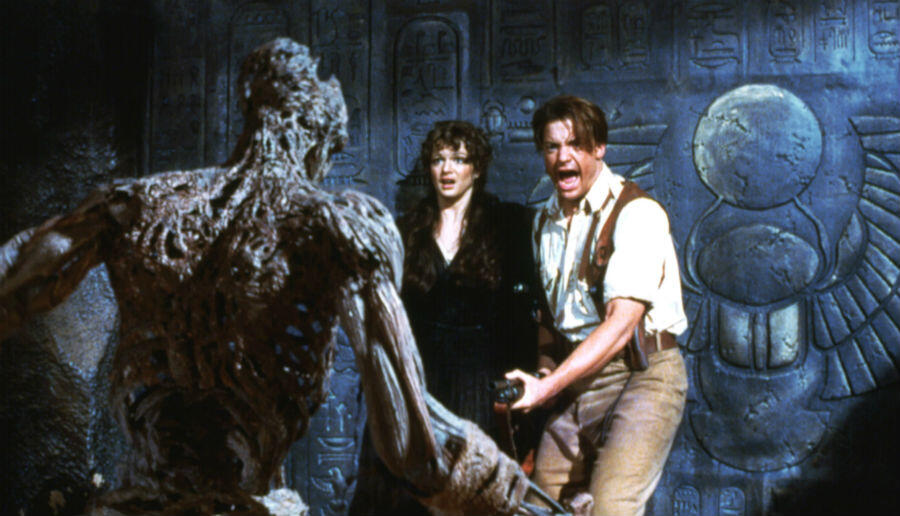
The Mummy (1999)
The 1932 fright flick was inspired by the discovery of King Tutankhamun's tomb in 1923 as well as the so-called "curse of the pharoahs" supposedly cast upon anyone who disturbed a mummy, a myth that persisted through the centuries. Universal Studios' resurrection of the film in the 1990s elicited interest from Clive Barker, George A. Romero and Joe Dante, before director Stephen Sommers' more adventurous, horror-lite tale made it to the big screen.
Bram Stoker's Dracula (1992)

First published in 1897, Bram Stoker's novel reflected his extensive research into European folklore, focusing on vampires, which had been the subject of other fictional works in the 19th century. Francis Ford Coppola's version in 1992 brought an erotic angle to the characters, clothed with spectacularly colorful costumes and and surrounded by elegant production design, all reproduced on sound stages and produced without the aid of computer-generated visual effects.