Creating The Good Dinosaur began with one simple question: What if approximately 65 million years ago a giant asteroid didn’t come into contact with our planet? Soon that one question turned into many.
What if dinosaurs weren’t obliterated? What if dinosaurs coexisted with man? And what if said dinosaurs were also cute, friendly and even colorful?
At a recent presentation at Pixar, Good Dinosaur codirector Peter Sohn and the rest of team shed a little light on how they put themselves in a prehistoric state of mind to imagine dinosaurs roaming and reigning on Earth with humans there to keep them company.

Make Room for Arlo:
Sohn explained that the movie centers on a “story about a boy and his dog.” Only in this case, the “boy” is a dino named Arlo and his sidekick is a human but puppyish pal called Spot. While Sohn worked on this narrative, the story team and screenwriter Meg LeFauve (Inside Out and the upcoming Captain Marvel) needed to create their star apatosaurus. The adolescent Arlo is adorable and LARGE, especially in comparison to Spot. To be sure they kept Arlo’s height in mind when building his world, the art team printed out a full-size, 18-foot mock-up of the dino to use as a reference.

Navigating the Dramatic Landscape
The film doesn’t just feature a dinosaur and his buddy. In addition, the epic landscape has a starring role. The valleys, the vistas, the mountains and the raging river all share the screen. The filmmakers took several research trips to Wyoming (where dinosaurs once roamed), to Oregon (to go on a cattle drive), and they rode the rapids down the American River to ensure that they accurately captured the essence and unspoiled beauty of the Western landscape. The river in the film acts as their “yellow-brick road,” the guide for Arlo’s journey.
For inspiration, the filmmakers also looked at landscape artists as well as films such as Never Cry Wolf, Shane, 7 Years in Tibet, Heaven’s Gate and Dancing with Wolves.
Then they got scientific. To create Arlo’s world, they used U.S. geological data as a foundation for the backgrounds, reflecting in detail our real world for Arlo’s world. The filmmakers studied trees and created a library of them – including aspen, willow, ponderosa, cottonwoods, lodgepole pines, chokecherries and spruce. They also created a collection of about 100 cloud forms that they could arrange to give that “big sky” feel.

Walk of the Dinosaurs
Pixar lucked out with this one. Its in-house sculptor Greg Dykstra is an expert on dinosaurs who goes on excavations for vacation, and he brought the studio a wealth of knowledge to create the forms for the dinos in the film.
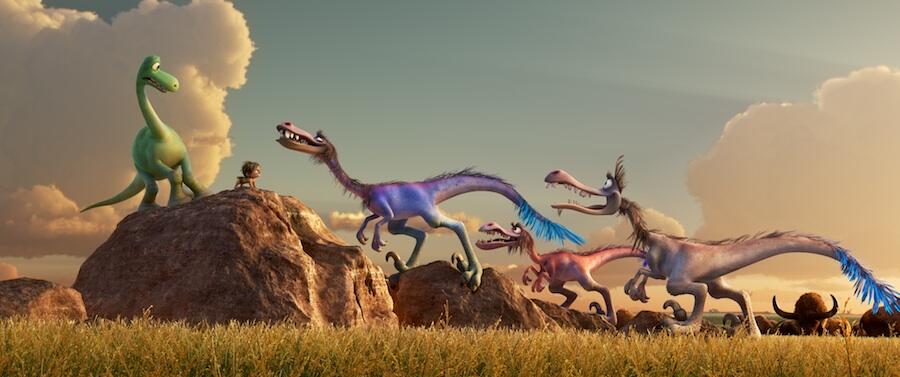
Pixar artists were able to take liberties with their prehistoric pals, from devising a sweet and appealing look for Arlo to opting to give velociraptors purple plumes. Beyond appearance, they also had to add movement. To understand how a massive quadruped walks, a team filmed the gait of elephants at a local zoo. Although an elephant is much smaller than an apatosaurus (they can grow to 75 feet) that footage inspired Arlo’s moves. For the T. rexes, who take on the roles of ranchers in the film, the team studied the gait of horses and gave them a trotting step.
It’s fascinating to get a peek at the huge amount of research, effort and work that goes on behind the scenes. You can check out the final product when it opens in theaters November 25.
Sunny Chanel is a regular contributor to Fandango Family, Babble.com, Mom.me, Disney Imagicademy and Mommy Nearest as well as her own whimsical site Wonder and Company. When she isn't writing, watching movies or doing crafts, she is playing dress up with her 9-year-old daughter.